Say you have about 10 bucks, and someone asks you to pay for them using it. Will you give it? Say you have 100, 1000. Keep increasing the limit of the amount of money that you have and keep asking yourself, Will you give it up for someone?
The amount at which you start having second thoughts doesn’t define you as a person. I am not here to judge you, but I am definitely here to tell you the story of King Shibi- the king who gave up his flesh (skinned himself alive) and then eventually offered his life as per his Rajadharma.
So, this is what happened.
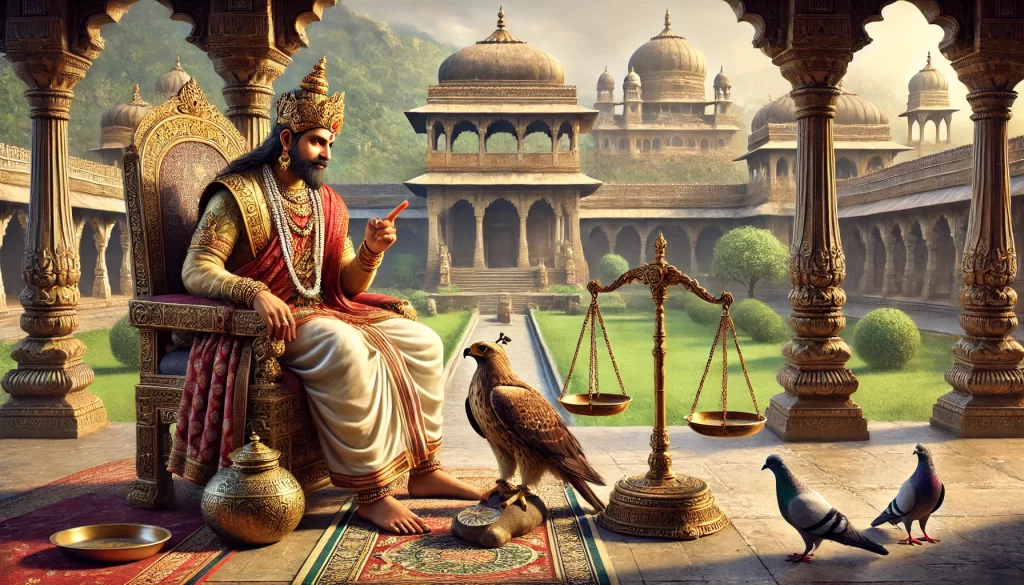
King Shibi, renowned for his justice, kindness, and sense of duty, ruled his kingdom with great wisdom. One day, as he sat in his court, a dove flew in, trembling and desperate. It landed on his lap and cried out for protection. A moment later, a ferocious hawk entered, demanding the dove as its rightful prey.
The hawk said, “O King, this dove is my food. By protecting it, you are denying me my sustenance. Is this justice?”
Shibi, firm in his role as protector, replied, “While it is true that every creature must eat, it is my dharma as a king to offer refuge to those who seek my protection. I cannot let this dove come to harm.”
Testing Shibi’s resolve, the hawk retorted, “If you deny me my prey, you must compensate me. I demand an equal portion of your flesh in return for the dove’s life.”
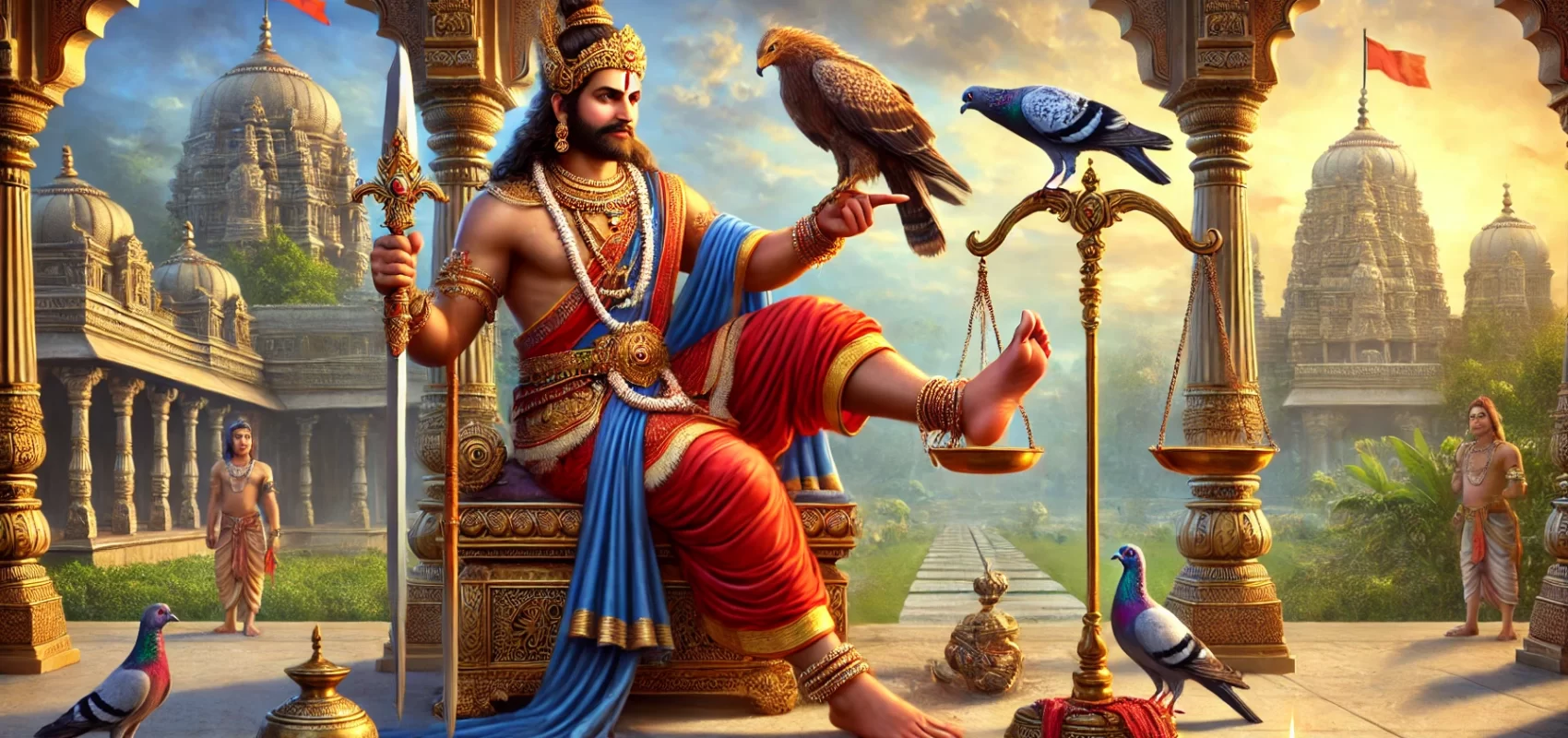
Without hesitation, King Shibi agreed. He placed the dove on one side of a balance and began cutting pieces of his flesh to weigh against the bird. However, no matter how much flesh he added, it could not equal the weight of the tiny dove. Finally, Shibi climbed onto the scale himself, offering his entire body.
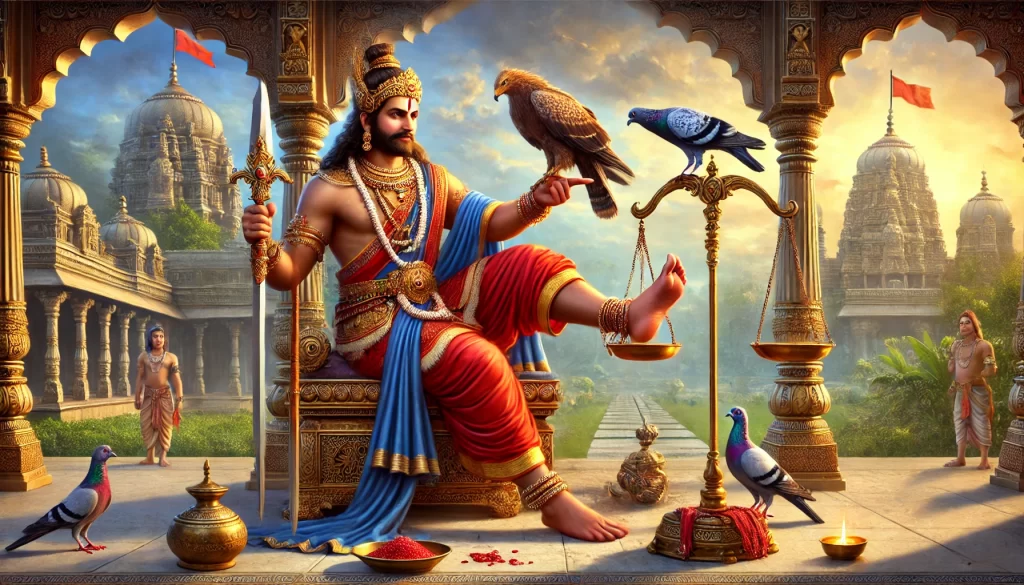
At this moment, the gods revealed their true forms. The dove was Agni (the god of fire), and the hawk was Indra (the king of gods). They had disguised themselves to test Shibi’s commitment to righteousness. Pleased by his selflessness, they blessed him with strength, prosperity, and glory, declaring him a paragon of virtue.
The story of King Shibi isn’t just a tale from ancient times—it’s like a life manual wrapped in an inspiring narrative! Think about it: Shibi didn’t just talk the talk; he literally weighed himself on the scale to protect someone weaker. That level of commitment isn’t just rare—it’s legendary.

So, what can we take away from this?
- Standing Up for the Vulnerable: Whether it’s standing up against unfairness or lending a helping hand, Shibi’s story reminds us that true power lies in protecting those who need it most. It’s not about being the strongest but about being the most steadfast in doing what’s right.
- Sacrifice and Selflessness: Let’s be real—giving up your comfort (or, in Shibi’s case, your flesh) isn’t easy. But the story teaches us that greatness comes when we put others’ needs before our own, especially when it’s tough.
- Moral Leadership: Whether you’re leading a team at work or making decisions in your daily life, it’s about sticking to your principles, even when the stakes are high. Shibi didn’t waver, and that’s the kind of leadership that leaves a lasting legacy.
Why this matters now:
In today’s world, where quick fixes and shortcuts often take center stage, King Shibi’s story is a call to action. It tells us to be steadfast in our values and to remember that real greatness is about lifting others up, even when it’s inconvenient. Because, in the end, it’s our actions that define who we are.
As the Bhagavad Gita beautifully says: “यद्यदाचरति श्रेष्ठस्तत्तदेवेतरो जनः।
स यत्प्रमाणं कुरुते लोकस्तदनुवर्तते॥”
(Yad yad acharati shreshthas tat tad evetaro janah,
Sa yat pramanam kurute lokas tad anuvartate.)
(Chapter 3, Verse 21)
Translation: “Whatever a great person does, others follow. Whatever standard they set, the world emulates.”
So, let’s be like Shibi—leading with courage, kindness, and an unshakeable sense of responsibility. Who knows? Maybe one day, your story will inspire someone, too!