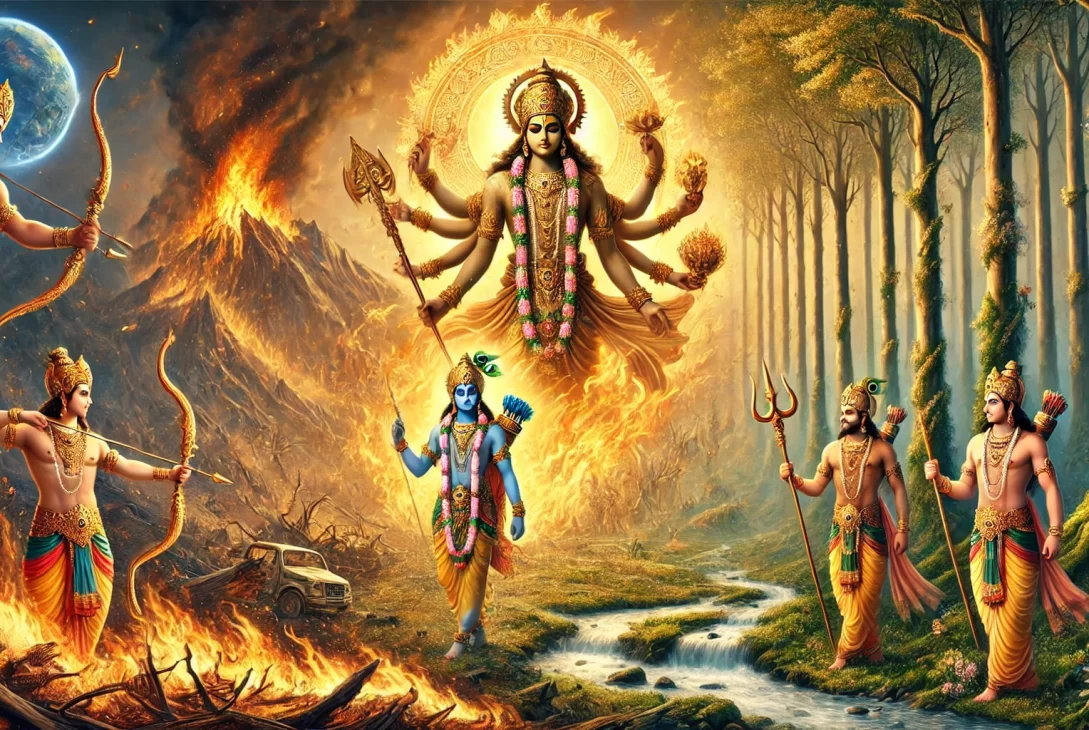
Imagine a conflict where nature, destiny, and cosmic forces collide, kind of like when you’re trying to balance work deadlines, family time, and fitness goals—except, here, it’s gods, curses, and forests on fire! This is the story of the Nagas of Khandava Forest, their cursed fate, and how two legendary heroes, Arjuna and Krishna, stepped in to turn things around.
The Nagas and Their Curse

Long ago, the Khandava Forest wasn’t just any forest—it was home to the Nagas, serpent-like beings with immense power and mystique. They lived peacefully among the lush trees and thriving wildlife, but their past misdeeds had landed them in hot water (well, fiery water). The Nagas had been cursed that one day the forest, their sanctuary, would be consumed entirely by Agni, the god of fire.
Now, Agni wasn’t acting out of spite. He had his own problems. He was feeling bloated and sluggish after overindulging during a yajna (sacrificial ritual)—think of it as a celestial food coma. The only way for him to regain his strength was by devouring something vast and potent, like the vibrant Khandava Forest. But every time he tried, Indra, the king of the gods, would show up with his rainstorms to douse the flames, protecting the Nagas and the forest.
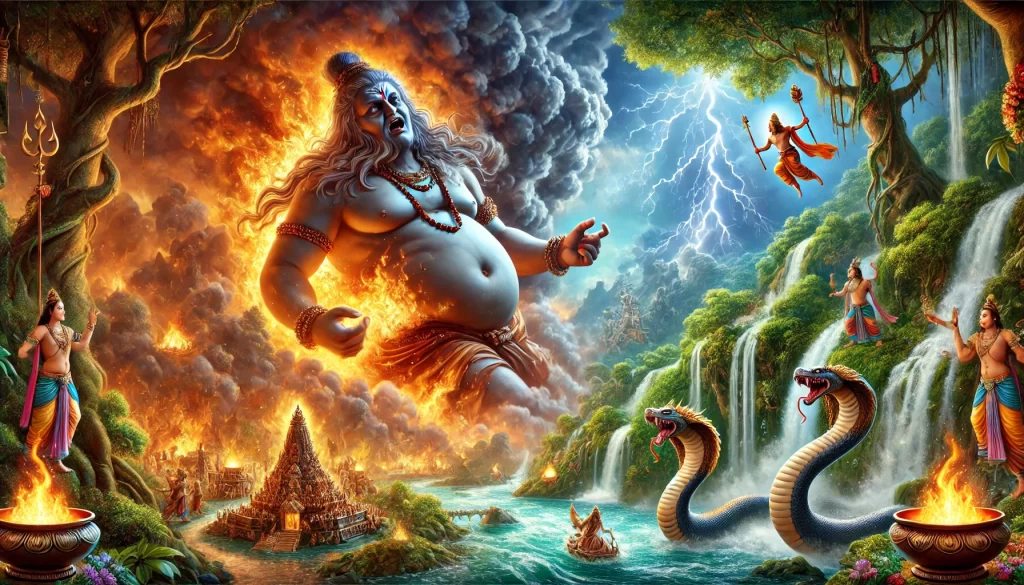
Agni, desperate to fulfill his cosmic duty, needed backup. That’s when he approached two of the greatest heroes of the Mahabharata—Arjuna, the master archer, and Krishna, the wise strategist.
Agni’s Plea and the Heroes’ Promise
Agni explained his plight to Krishna and Arjuna. He needed the forest to fulfil his divine purpose, but Indra, wielding his thunder and rain, was making it impossible. Arjuna and Krishna, understanding the cosmic balance at stake, agreed to help Agni, provided the innocent beings in the forest were spared wherever possible.
As Agni ignited the forest with his blazing flames, Indra descended, furious and determined to stop the destruction. What followed was an epic celestial battle.
The Battle of Fire and Rain
Picture this: Arjuna, standing firm with his mighty bow Gandiva, shoots a continuous volley of arrows that form an impenetrable shield above the forest. No matter how fiercely Indra’s rain poured, not a single drop could reach the flames. Krishna, meanwhile, wielded his Sudarshana Chakra with unmatched precision, countering every obstacle Indra threw their way.
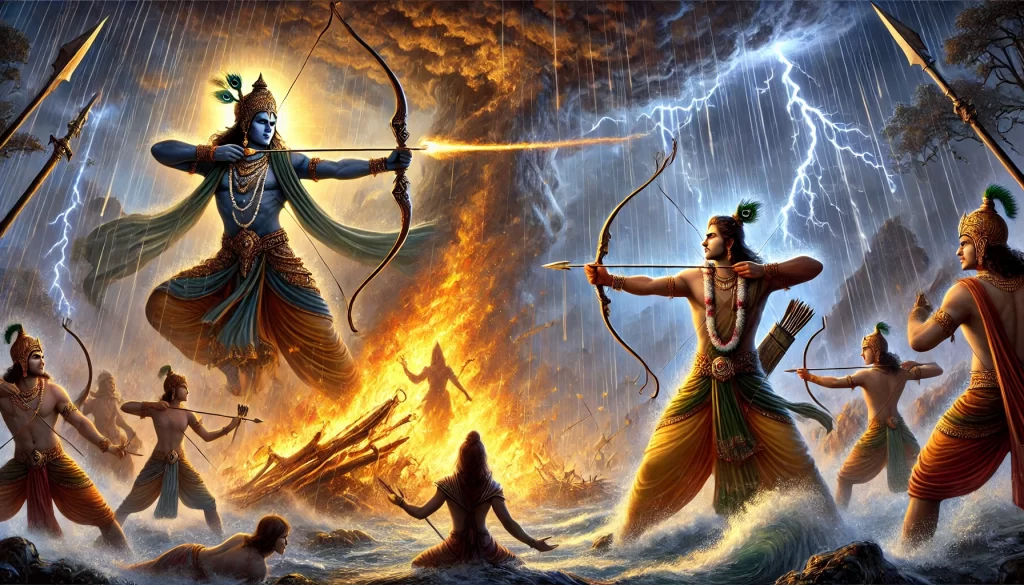
While the forest burned, some of the Nagas, fulfilling their cursed fate, perished. But Arjuna, true to his promise, ensured that others, including the mighty Takshaka, were spared. It was a bittersweet moment: the curse was fulfilled, but it also paved the way for renewal and balance in the natural order.
The Aftermath
The destruction of the Khandava Forest wasn’t just about the curse—it symbolized the cycle of destruction and creation, a reset for the world to flourish anew. For Agni, it was a moment of redemption; for Arjuna and Krishna, it was another chapter in their journey as protectors of balance and dharma.
Lessons for Today
- Balancing Destruction and Renewal: Just like clearing clutter to make space for something new, sometimes destruction paves the way for growth and balance.
- Stepping Up When It Matters: Arjuna and Krishna remind us that standing up for a cause, even against great odds, is what true leadership looks like.
- Fate Meets Free Will: While the Nagas’ curse was inevitable, the intervention of heroes showed that free will can still shape outcomes with compassion and justice.
As the Mahabharata teaches:
“धर्म एव हतो हन्ति धर्मो रक्षति रक्षितः।
तस्माद्धर्मो न हन्तव्यः मा नो धर्मो हतोऽवधीत्॥”
(Dharma eva hato hanti dharmo rakṣati rakṣitaḥ,
Tasmād dharmo na hantavyaḥ mā no dharmo hato’vadhīt.)
Translation:
“Dharma, when destroyed, destroys the destroyer. Dharma, when protected, protects its protector.”
The story of the Khandava Forest reminds us that even in the face of seemingly inevitable destruction, there’s always room for balance, compassion, and heroic intervention. Whether it’s about cosmic fires or our own daily battles, the lesson remains the same—face challenges with resolve, protect what matters, and trust that renewal follows every ending.
Why Were the Nagas Cursed?
The Nagas, mystical serpent beings, are often portrayed as powerful but occasionally arrogant. Their curse is said to stem from a combination of factors:

Misuse of Power: The Nagas were known for their immense strength and venomous abilities. At times, some Nagas abused their powers, causing harm to others or disrupting cosmic harmony. In Hindu tradition, misuse of power often attracts divine consequences.

Ancestral Wrongs: The Nagas had a history of enmity with other beings, especially the Garudas, their eternal rivals. This hostility often led to violent clashes and imbalances in the natural order. The curse could have been a result of these ongoing conflicts.

Specific Transgressions: Some texts hint that the Nagas of Khandava may have committed a specific offense against the gods or sages. For instance, in certain legends, the Nagas are said to have hoarded wealth or knowledge meant for the greater good, invoking divine wrath.

A Part of the Grand Design: In some interpretations, the curse wasn’t a punishment for wrongdoing but rather a necessary part of the cosmic cycle. The destruction of Khandava Forest was destined to create a balance in the world, and the Nagas’ role in this cycle required them to face destruction and renewal.